Buyer-Funded Virtual Cards: When CFOs Should Pay the Interchange Themselves

For about a decade, the conversation about virtual card adoption has run on the same loop. AP wants the rebate. Procurement gets the call from the supplier. The supplier says they will not absorb the interchange. AP shrugs, sends an ACH, and moves on. Everyone goes home convinced that virtual cards are a "supplier acceptance problem."
That framing is wrong, and it has been wrong for years. The reason it persists is that almost every piece of card content treats interchange as a cost the supplier is supposed to swallow in exchange for faster funds. Reframe it. Interchange is a price tag on a financing product the buyer is purchasing. The question isn't whether the supplier will accept the card. The question is whether the buyer should pay for the float.
For a lot of mid-market and enterprise CFOs right now, the answer is yes, and they're leaving the option on the table because nobody priced it correctly.
The Frame: Interchange Is a Coupon, Not a Cost
Stop thinking of a virtual card payment as "ACH plus a fee." Think of it as a short-term loan you're buying at the point of payment.
When you push a payment through a virtual card rail, you are not paying the supplier today. You are paying the card network today and paying your card account on its statement cycle. That gap, typically somewhere between 25 and 55 days depending on when in the cycle the charge lands, is working capital. It's not free, but it's not zero-utility either. It's a fixed-duration, non-revolving, unsecured advance with no covenants, no draw notice, no commitment fee, and no impact on your credit facility's availability.
Priced that way, interchange is the coupon on a private placement that settles automatically. And like any coupon, what matters is the yield relative to your alternatives.
This is the conversation most AP teams have never had with their treasurer. It's also the one that flips buyer-funded virtual cards from "weird workaround" to "default tool for a specific class of payments."
When the Math Actually Works
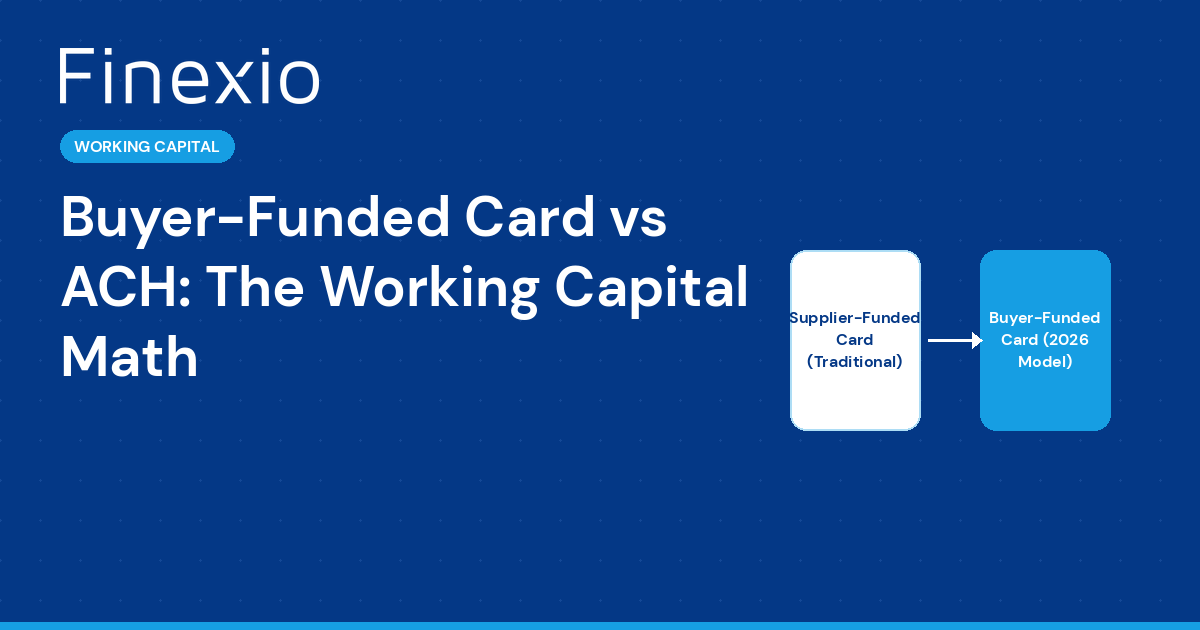
A buyer-funded virtual card means exactly what it sounds like. The buyer agrees to absorb the interchange so the supplier receives the full invoice amount, settled instantly, with no discount. The supplier gets ACH-equivalent economics. The buyer gets the float and, depending on the program structure, still earns rebate on the spend.
Here's when that math works in the buyer's favor, sequenced from cleanest to most situational.
1. When your marginal cost of debt exceeds the annualized interchange. This is the headline case. If you're drawing on a revolver to fund operating outflows, the all-in cost of that draw, including the spread over your benchmark rate, the unused-line fee, and the opportunity cost on your borrowing base, is your true comparison. Run the annualized rate on a virtual card payment held for 40 days against your marginal revolver cost. For a lot of mid-market borrowers in the current rate environment, the card is cheaper. Not by a little.
2. When the payment would otherwise trigger a covenant pressure point. Quarter-end and year-end matter. If pushing a large ACH on March 30 drops your cash position below a measurement threshold, buying 30 days of float with interchange is materially cheaper than the renegotiation that follows a covenant trip. Most CFOs price this risk at zero until they've lived through one. After that, they price it correctly.
3. When DPO extension would damage the supplier relationship but cash timing demands it. This is the underrated case. You can't push the supplier to net-75. They'll either reprice next renewal or deprioritize your orders. But you can pay them on net-30 with a virtual card and effectively run net-65 against your own cash. The supplier sees a faster, more reliable payment. You get the working capital. Nobody is angry.
4. When you're funding a one-time spike. M&A integration spend, ERP implementation milestones, a large inventory build. These are the payments where a buyer-funded card converts a treasury problem into a routine AP run.
The CFO who runs cash flow tightly already knows the cash-flow cycle is the lever that matters most. As PYMNTS Intelligence has documented, 77.9% of CFOs see improving the cash flow cycle as "very or extremely important" to their strategy in the year ahead (Source: PYMNTS Intelligence, https://www.pymnts.com/cfo/2024/cfos-look-to-working-capital-solutions-to-improve-cash-flow/). What buyer-funded cards add is a lever that doesn't require renegotiating terms, extending DPO, or pulling on the revolver.
The Three-Party Model That Makes This Possible
A quick word on plumbing, because the model only works if the rails behind it are real.
Finexio is the orchestration layer. J.P. Morgan Chase is the issuing bank. Mastercard and Visa are the networks. That three-party structure is what makes a buyer-funded virtual card behave like a settled bank product rather than a fintech experiment. The credit relationship sits with a money-center bank. The network economics sit with the card brands. Finexio sits in the middle, handling supplier enablement, payment routing, reconciliation back into your ERP, and the fraud controls that make virtual cards safer than the ACH file most teams trust without a second thought.
That matters for buyer-funded specifically because the program design, who absorbs interchange, how rebate is calculated, how each supplier is enabled, has to be configurable per-payee. A flat "all suppliers eat the fee" model is what made the last decade of card adoption stall. A per-supplier policy, enforced at the payment-method-selection step, is what unlocks the working-capital play. That's a virtual card payments capability, not a generic AP feature.
The Playbook: How to Operationalize Buyer-Funded Selectively
You do not want to make every payment a buyer-funded card. That's the trap. You want a policy that routes payments to buyer-funded only when the math works, and routes everything else to its natural rail. Here's the sequence.
Step 1: Segment your supplier file by acceptance posture. Three buckets. Suppliers who already accept cards and absorb interchange. Suppliers who refuse cards on any terms. Suppliers who refuse interchange but would accept a card if delivered at par. Your buyer-funded program lives entirely in bucket three. Most AP teams have never built bucket three because no one asked. It's usually a meaningful portion of the file by spend.
Step 2: Set a working-capital benchmark rate. Have treasury publish a monthly "marginal cost of cash" number. This is the rate AP uses to evaluate whether a buyer-funded card beats the alternative for any given payment. Without this number, AP has no decision rule and the program collapses into ad-hoc judgment.
Step 3: Build the routing logic at the payment-method level. For every approved invoice over a threshold, the system should evaluate: supplier acceptance posture, days to due date, treasury's benchmark rate, and the program's effective interchange. If buyer-funded math wins, route there. If not, route to ACH or the supplier's preferred card terms. This is exactly what a properly configured payment operations layer does without humans intervening per-payment.
Step 4: Reconcile rebate and interchange separately. This is where finance teams get lost. Rebate revenue belongs in one GL account. Interchange-as-financing-cost belongs in another, ideally classified alongside interest expense so the CFO can see the all-in working-capital cost of the program in one view. If they net against each other in a single line, you've hidden the analytics that justify the program.
Step 5: Layer fraud controls on the buyer-funded segment. Buyer-funded cards have a specific risk profile because the buyer is committing to absorb the fee regardless of dispute outcome. Single-use card numbers, exact-amount authorizations, and supplier-locked MCC restrictions are the baseline. Finexio Shield carries a $2M fraud guarantee that sits on top of those controls, which is the right backstop for a program where you've voluntarily accepted more economic exposure than a standard card payment.
The Objection That's About to Disappear
The standard CFO objection to buyer-funded is "we'd be paying interchange on payments that used to be free." That sentence is doing a lot of hidden work. ACH isn't free. It has a per-transaction cost, a fraud cost priced into your insurance and reserve posture, a reconciliation cost in headcount, and an opportunity cost in the float you're giving away to the supplier.
When you fully load those, the gap between ACH and a buyer-funded card narrows considerably before you've added the working-capital benefit. Add the float, properly priced against your marginal cost of debt, and on a meaningful slice of your spend, buyer-funded is the cheaper rail.
CFOs who get this early get a balance sheet tool their peers don't have. CFOs who keep treating interchange as a fee to be avoided are leaving working capital on the floor.
FAQ
Doesn't paying interchange ourselves just transfer cost from supplier to buyer with no net benefit?
Only if you ignore the float. The interchange purchases a financing instrument, time between when the supplier is paid and when your card balance settles. Compared against your marginal cost of debt, that financing is often cheaper than the alternatives. The "transfer" framing assumes interchange has no offsetting value, which is the same mistake people make when they call insurance premiums a "cost."
How do we avoid this becoming a back-door way to extend DPO and damage supplier relationships?
You don't extend supplier terms. The supplier is paid at par on the invoice's actual due date. The float you capture is between your card statement cycle and your payment to the card account, which is entirely on your side of the relationship. The supplier sees a faster, cleaner payment than ACH. That's the point.
What size of program makes this worth operationalizing?
If you have meaningful AP spend with suppliers who refuse to absorb interchange but would accept a card at par, and your marginal cost of debt is above the program's effective interchange, the math starts working at a surprisingly modest scale. The bigger gating factor is whether your payment infrastructure can route per-supplier instead of by blanket rule.
Where to Take This
Buyer-funded virtual cards are not a niche tactic. They're a working-capital lever that most mid-market and enterprise AP programs have left unused because the framing was wrong. Price the interchange like a coupon, route the payments like a treasurer would, and the program pays for itself before the rebate even shows up.
If you want to see the per-supplier routing logic and what the program looks like running on J.P. Morgan Chase rails with the Mastercard and Visa networks behind it, Book a Consultation.
Sources
- PYMNTS Intelligence: https://www.pymnts.com/cfo/2024/cfos-look-to-working-capital-solutions-to-improve-cash-flow/
Get the free Newsletter
Get the latest information on all things related to B2B and electronic payments delivered straight to your inbox.